



















On October 1st, 2025, America’s government shut down due to disagreements in Congress over spending priorities. This shutdown had major consequences for food security across the country, especially for those who were already struggling. One of the most affected programs was SNAP (Supplemental Nutrition Assistance Program ), which helps millions of Americans afford their groceries each month. Thus, when the shutdown occurred, SNAP benefits were paused and delayed, causing millions of citizens to lose the federal grocery assistance they depended on.
“Before the government shutdown, our food pantry was serving about 1,800 to 2,000 households per month,” said Rick Doane, Executive Director at Interfaith Social Services in Quincy. “Even before the shutdown, our food pantry was serving twice as many households per month as we were at the height of the pandemic. Massachusetts is one of the most expensive states in the country to live in. The high cost of housing continues to drive many people to food pantries.”
Families in the local community were already struggling to afford basic necessities before the government shutdown. Thus, when the shutdown came into full effect, this situation quickly worsened. The SNAP benefits were paused, and many families who normally depended on these benefits were suddenly left without support.
“The number of households being served increased during the SNAP food crisis,” Doane explained. “The increase was predominantly from new clients. We were registering four times as many new clients each day as we normally do.”
Many people who hadn’t relied on food pantries before were now forced to seek help due to the lack of SNAP benefits. Along with this increase in need came fear and confusion.
“One of the things that we saw the most during the crisis was the fear that existed in the community,” Doane said. “[People] were scared that our food pantry would be closed because the federal government was closed. As the SNAP crisis began, we got many more scared phone calls from people who could not access food.”
As demand increased, food pantries also had to adjust their operations.
“We absolutely saw longer lines because of the crisis and we had to accommodate it by opening our food pantry 1 hour early so that we could serve all of the clients who were coming to us for help,” Doane said.
This impact was not limited to Quincy. Across the region, larger organizations like the Greater Boston Food Bank (GBFB) experienced similar effects as their partner agencies saw dramatic increases in need.
“The Greater Boston Food Bank services 190 cities and towns. We have 600 agency partners, [and] we purchase food [to] distribute it to agency partners,” explained Senior Manager of Foundation Relations Elizabreth Landrum at GBFB.
In Boston, the Greater Boston Food Bank saw a similar pattern where citizens were reaching out to food pantries more than ever to get the help that the federal government lacked to provide.
“We had a partner agency report 3 to 4 times the number of client attendance at their distributions during the pause in benefits in November,” Landrum stated. “We also saw 4 times the traffic on the ‘Need Food’ part of our website. If people are experiencing food insecurity, they can go to our website, click the ‘Need Food’ page, and then that takes them to their local pantry information.”
Despite these immense challenges, food pantries and food banks worked tirelessly to keep up with the surge.
“We spent significantly more on food during the early part of November,” Doane said.
“GBFB increased our food purchasing in the months of October and November to bring in 50 additional pallets of food a day,” Landrum added.
Not only did they both increase the amount spent on food, they both were able to maintain the freshness of their products and make sure families had the bare necessities.
“We were having multiple trucks arriving daily with fresh produce, eggs, etc.” Doane said.
“Now, we’ve increased the amount of food and the amount of full palates, as well as added in fresh produce deliveries” Landrum from GBFB stated.
Community support played a critical role during the SNAP crisis. Donations increased significantly, and many new supporters stepped forward.
“The response from the public was amazing. We received hundreds of donations from individuals who had previously never contributed to our organization and our current donors increased their giving significantly,” Doane said.
Similarly, GBFB received strong backing. “We’re very fortunate that we’ve had several donors step up and provide a matching donation challenge. So at the current moment, any new donations to the Greater Boston Food Bank are being doubled until the end of the year,” Landrum stated.
Locally, the Braintree community also took action. As the demand for necessities increased, some families don’t prioritize gifts for their children. Through Adopt-A-Family, Braintree High School’s Student Council was able to support families in need during the holidays.
“Adopt-A-Family” is a fundraiser where Braintree High School clubs and individual participants raise money to support families this holiday season. Clubs are given a family and are in charge of collecting donations for gift cards for
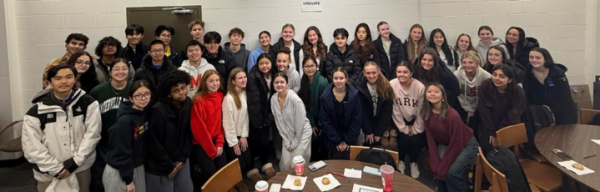
stores on their wishlist. This year, a total of $9,000 was raised across all clubs” said junior STUCO member Aditi Jhamtani.
“The goal [is] ultimately giving back to the community. It’s important that everyone can afford to have a Christmas dinner with clothes and presents for their family,” said senior STUCO member Jacob Brabant.
The government shutdown officially ended as of November 12th, 2025, when President Trump and Congress passed a bill that restored government funding and federal operations. SNAP benefits were reinstated, bringing relief to food pantries and families across the country.
Landrum stated, “The need is still incredibly great, but of course, SNAP is the most effective tool for solving hunger because the cost of SNAP is much less than the cost of other emergency food distribution systems. We’re very grateful that SNAP has been reinstated and we think that that was absolutely the right choice.”